
There's a problem with using AI to do serious preparedness work, and anyone who's used AI long enough has run into it. The language is good. The facts aren't — or at least, not always, and you can't tell when.
An AI can draft a hurricane scenario for a hospital that sounds exactly like the real thing — the cadence of incident command, the texture of public messaging, the right acronyms in the right places. But ask it whether the configured population in the scenario matches the actual county. Ask it which CMS regulations are binding for that facility. Ask it what realistically happens to fuel reserves over 72 hours of generator load. The AI will answer all three confidently. Two of those answers will be wrong, and you won't be able to tell which two.
For a casual brainstorm, that's a minor annoyance. For a compliance exercise, an after-action review, or training that informs real plans, it's disqualifying.
Preppr is built around a different architecture, and it's worth describing plainly because it changes what AI in this domain can actually be trusted to do.
The Engine Is the Source of Truth
At the center of Preppr is a new piece of software we call the Compliance & Operational Physics Engine. It's not a chatbot. It's a deterministic simulator — software that, given a description of an entity under stress (a single facility, an organization, a jurisdiction, or a whole community) and a hazard, runs it forward through time according to rules and equations.
The engine carries two kinds of authoritative ground truth — rules and data — and runs two kinds of “physics” against them, side by side, over a shared simulated world.
Compliance physics. The full force of federal, state, accreditation, and sector-specific rules — currently 489 and growing, across 18 sectors — evaluate continuously against that world. When fuel drops below the critical threshold, the CISA notification deadline starts. When water pressure falls, EPA's Tier 1 public-notice clock activates. When a federal declaration arrives, a different set of grant-eligible obligations turns on. Every rule is tied to a real citation — CMS 482.41, AWIA 2013, 44 CFR 206, NFPA 1600 — not a paraphrase, not a guess.
Operational physics. What actually happens during the incident. Hazards onset and worsen. Fuel and water and staffing burn down at sector-appropriate rates. People get fatigued. The public surges into the ER. Power loss cascades into communications degradation cascades into command disruption. Impact gets weighted by the real social-vulnerability profile of the affected population, drawn from authoritative sources the engine grounds against — FEMA's National Risk Index across all 3,232 U.S. counties and 56 states for vulnerability and exposure, FEMA Hazus for earthquake loss baselines, curated outbreak signal for emerging infectious disease where the engine has it. The list of registered sources grows as the engine takes on new hazards and regions.
Re-run the same scenario with the same inputs and you get a bit-for-bit identical audit log. Every event in the log carries its rule id, citation, and provenance hash. That's the difference between a defensible answer and a confident-sounding one.
The Language Models Write the Story
The engine, on its own, is austere. It tells you what's true, not what's interesting. That's where language models come in — and where most of the user experience lives.
When you build an exercise in Preppr's Exercise Designer, language models draft scenarios and write injects or pull on hazard mitigation plans, and frame the questions players will face. When you talk to Ask Preppr, language models compose answers, reason across your knowledge, and synthesize analysis. When you generate an alert template, an after-action report, or an EEG, language models do the writing.
Language models are good at this. They're good at language, at opinionated judgment, at framing, at synthesis. They can take a dry sequence of regulatory triggers and turn it into a scenario your partners will actually engage with. They can take the engine's terse “fuel reserves crossed critical threshold at T+47:00” and turn it into a narrative your leadership will respond to.
What they're not good at is keeping the truth straight, the rules current, or the cascades physically consistent. So Preppr doesn't ask them to.
Then the Engine Checks the Work
This is the part that matters. When a language-model output touches the live world, the engine validates it against the truth.
When Preppr’s Exercise Designer drafts a scenario, the configuration runs through the engine's plausibility check against the registered authoritative sources for that hazard and jurisdiction. If the configured magnitude is two full steps off the nearest modeled scenario for the county, or if the affected-population number is ten times the displaced-household estimates the data supports, the engine flags it before the scenario is frozen. The sources doing the checking are the engine's authoritative ground truth — NRI and Hazus today, and a growing set of registered feeds, like flood forecasting, UNDRR hazard profiles, and WHO epi data, as new hazards and regions come online.
When an action proposes citing 44 CFR 206.2, the engine verifies that the citation matches the loaded rule corpus and that the rule actually applies to the facility, sector, and hazard in question. A drafted citation that doesn't bind doesn't get stamped into the artifact.
When a scenario goes through pre-simulation validation, the engine surfaces which rules are actually on the hook — by jurisdiction scope, by sector, by capability — and reports them with their full citation chain. The language model can describe; the engine confirms.
When the language model and the engine disagree, the engine is authoritative. That's the contract. It's what keeps the AI-assisted parts of Preppr from drifting on vibes into something that feels right but isn't.
Extending What’s True — and What’s Knowable
The engine knows a lot. It doesn't know everything. And the language models, when they write the story, draw on more than just the engine — they also draw on the body of knowledge your organization brings to the table. Preppr is designed so both layers can grow, along two symmetric axes.
The engine extends through new authoritative ground truth — rules and data. Grounding extends through new bodies of knowledge — personal and shared.
Workspace data sources extend the engine (operational side). Your admin can register an external authoritative API — WHO's GREPI for global infectious-disease events, USGS earthquake feeds, your state's emergency-management open data, your sector's threat-intelligence service — as a new authoritative data source for your organization's scenarios. The engine fetches a sample, runs five validation gates (the data has to be present, the hazards have to be engine-known, the field mappings have to map to engine-consumable paths, the publisher has to be trustworthy or backed by an admin attestation), and then refreshes every 24 hours. Approved sources feed scenarios automatically, supplying defaults for jurisdictions FEMA doesn't cover and contributing cascading-hazard probabilities where the federal data has gaps. Federal data still wins on overlap. Every parameter the engine pulls from a registered source carries its origin with it; downstream artifacts trace back, source by source, to the authoritative material they're built on. Three authoritative sources, one coherent scenario, every parameter traceable.
Personal Knowledge Bases extend what the language models can ground against (private). Documents you upload, conversations you've had with Ask Preppr, intel briefs you've captured, exercise designs you've created, after-action findings from past work — they all flow into your personal Knowledge Base and become retrievable when you ask questions or design new artifacts. Ask Preppr cites them. Designer references them. They're how the AI knows what your organization has been working on, not just what's in the federal corpus.
Preppr Knowledge Collections (Packs, in the codebase) extend grounding across people (shared). A Collection is a curated body of content — doctrine, playbooks, lessons learned, sector best practices — that a team can subscribe to and share. When you turn a Collection on, its content becomes part of what Ask Preppr will cite and what Designer can draw on. Collections are how an organization's institutional knowledge becomes part of every member's AI-assisted work.
The first pair extends the engine — where truth is enforced, with citations and provenance. The second pair extends grounding — where story is generated, with retrievals that can be traced back to the document they came from. All four are admin-gated where they need to be, validated where validation matters, and structured so end users can't slip unverified content into the parts of the system that have to remain authoritative.
The Whole Thing Is Addressable
The engine, the simulator, your personal Knowledge Base, the Preppr Knowledge Collections you toggle on, the exercise designs you've built, the scenarios in your library — all of it is accessible via MCP, the Model Context Protocol. Read and write, both directions.
That means the AI tools your team already uses — Claude, ChatGPT, Copilot, whatever sits on your analysts' desktops — can query Preppr directly. An emergency manager working in Claude can ask “what would the engine say about a Category 3 hitting our coastal facilities,” get a real engine run back with citations, and pull the result into a brief without leaving the chat. A planner in their own tooling can pull a scenario out of Designer, edit it, and write it back. A researcher can query a Collection, retrieve grounded passages, and cite them in an analysis their organization will actually trust.
This matters for three reasons.
First, the truth-and-story architecture stops being a Preppr-only architecture. The engine's authoritative outputs — rule firings with citations, plausibility checks against registered sources, resource-burn calculations grounded in equations — can underwrite work happening in any AI surface your organization uses. The deterministic layer becomes a service the rest of your stack can lean on, not a walled garden you have to log into to benefit from.
Second, your institutional knowledge stops being trapped in the tool that captured it. Personal KBs, Collections, past exercise designs, after-action findings — they remain retrievable, citable, and groundable from wherever your team is actually working. The investment your organization makes in building up its substrate compounds across every AI-assisted workflow it touches, not just the ones that happen inside Preppr's UI.
Third, and most consequentially: the validation loop extends outward. When an external AI calls the engine through MCP, it gets the same audit log, the same citations, the same deterministic guarantees, and the same provenance trail that an internal call would get. The contract doesn't weaken at the boundary. The story can be written anywhere; the truth still has one source.
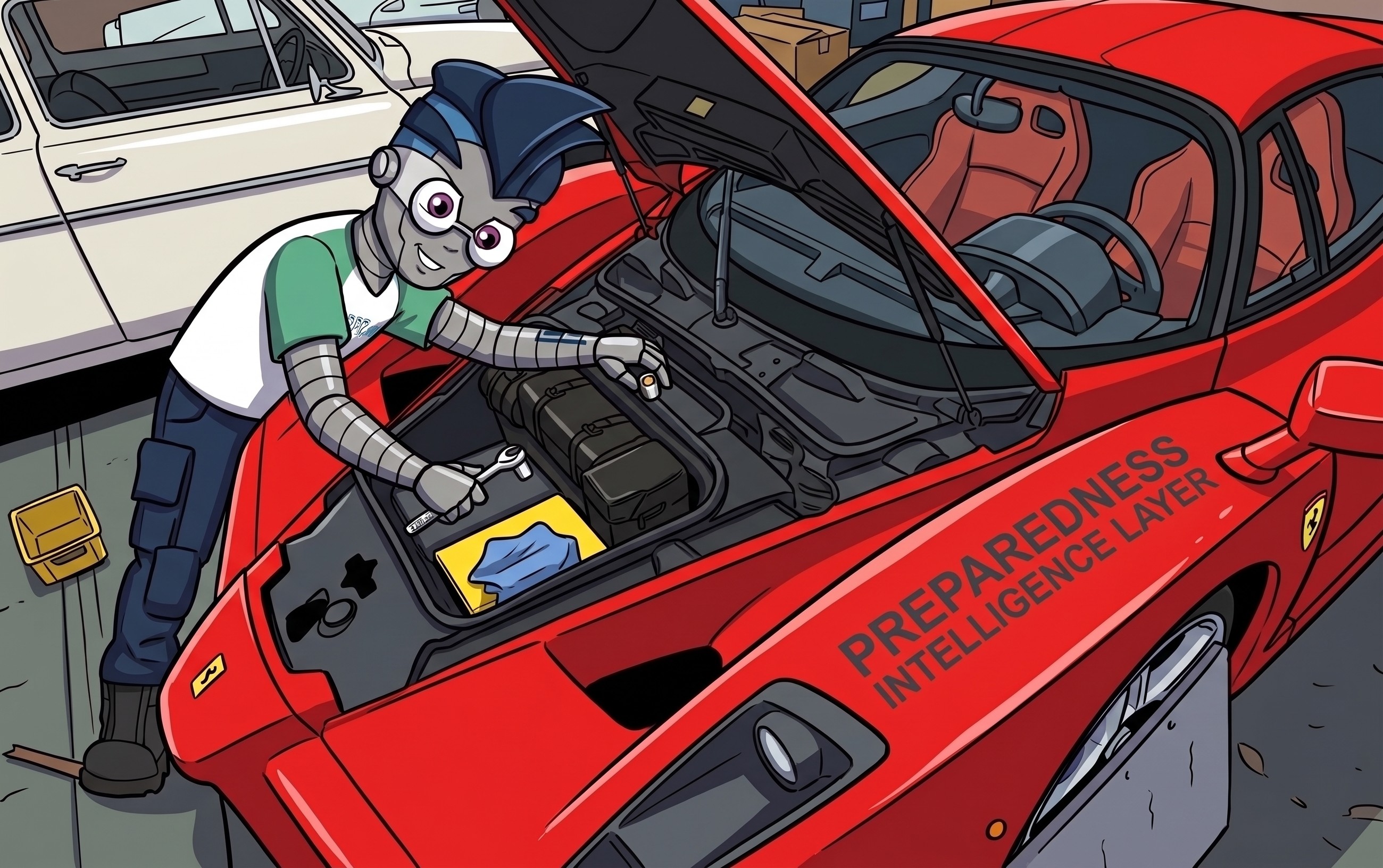
This is what we mean when we say Preppr is a preparedness intelligence layer, not an app. The app is one way in. MCP is how the layer becomes part of everything else.
Why This Matters
The architecture is, in the end, a stance: about what AI in critical-domain work should be doing and what it shouldn't.
Language models should do what they're good at — turning truth into story, drafting artifacts people will engage with, synthesizing across a body of knowledge, generating language that lands. They should not be asked to keep the regulatory deadlines current, the resource burn rates physically consistent, or the cascades accurate. Those are tasks for a deterministic engine grounded in real rules and real data, with citations and provenance attached.
The reason Preppr can produce defensible preparedness artifacts is that the engine sits underneath the whole thing, checking the language models' work at every step. Every rule that fires has a citation. Every resource level is traceable to an equation. Every plausibility warning is grounded in a registered authoritative source. Every retrieval is auditable back to a document in a KB or a Collection.
For an emergency manager, this means the AI-assisted work you do in Preppr is AI-assisted in the parts where AI is helpful — drafting, framing, narrative, synthesis — and not AI-assisted in the parts where it isn't: rules, numbers, physics, citations. The artifacts you put in front of leadership are grounded in real data and real regulation. The plans you build reflect what would actually apply to your facility, your organization, your jurisdiction, your community.
Truth and story, in the right roles, with a loop between them. That's the architecture.
Ready for emergency management AI you can actually trust? Book a demo.